Home Assistant
Four integrations for devices Home Assistant did not support — written because I wanted them in my own house and on my own tank.
Aquarium lighting
ATI Straton Flex
v0.19.2Brings ATI Straton Flex lights in. The integration talks to the light's own web interface on your network — no detour through a manufacturer's service.
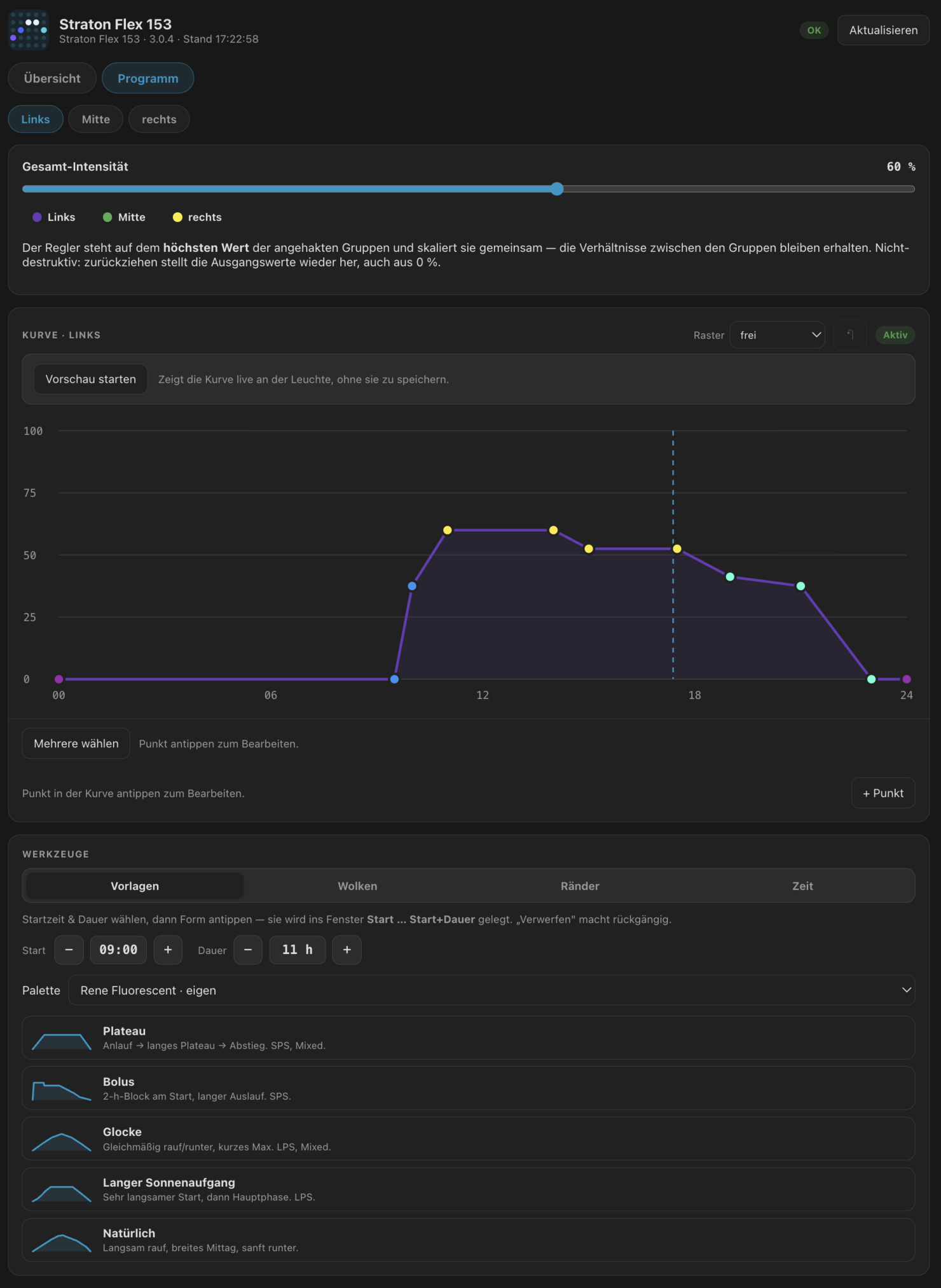
- Connection state, warning and danger flags, device type, firmware and uptime
- Estimated power draw in watts, using the formula from the web interface
- Values per section and per active program group
- Its own sidebar panel: the day curve drawn with time and intensity axes, the support points, a marker for the current time, and the colour spectrum channels
Deliberately read-only: it changes neither the light program nor demo mode, Wi-Fi, firmware or credentials.
Aquarium water testing
Reef Kinetics ReefBot
v0.16.7Brings the ReefBot automatic water tester into Home Assistant — the readings, the state of the machine, and the ability to start a test without opening the manufacturer's app.
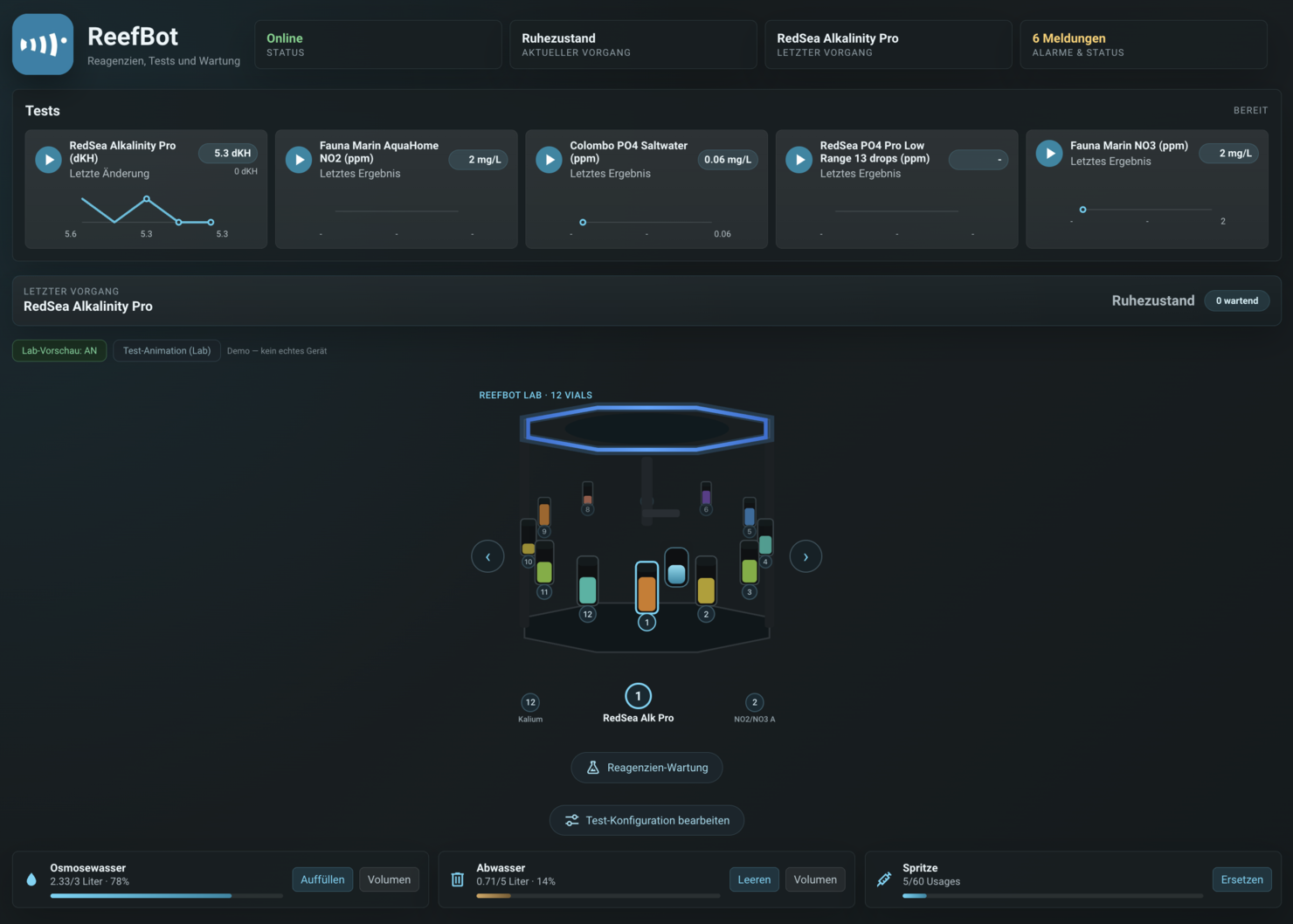
- Readings such as alkalinity, calcium, magnesium, nitrate and phosphate as sensors — ready for history, graphs and automations
- One button per configured test to start it
- Levels for the vials, RODI water and waste
- A sidebar panel that redraws the machine — vial carousel, chamber, syringe and levels instead of a wall of sensors
- Detects by itself whether a ReefBot V2 with eight or a ReefBot Lab with twelve vials is connected
Read-only by default; every write action is a button you press yourself. Credentials are used once for a token and never stored in plain text. The panel does not talk to the manufacturer's service, only to Home Assistant.
Aquarium pumps
JEBAO MDC
v0.4.9Controls JEBAO MDC flow pumps on your own network, with no cloud in between. The pumps are discovered by themselves.
- Discovery over UDP, state over TCP — both local
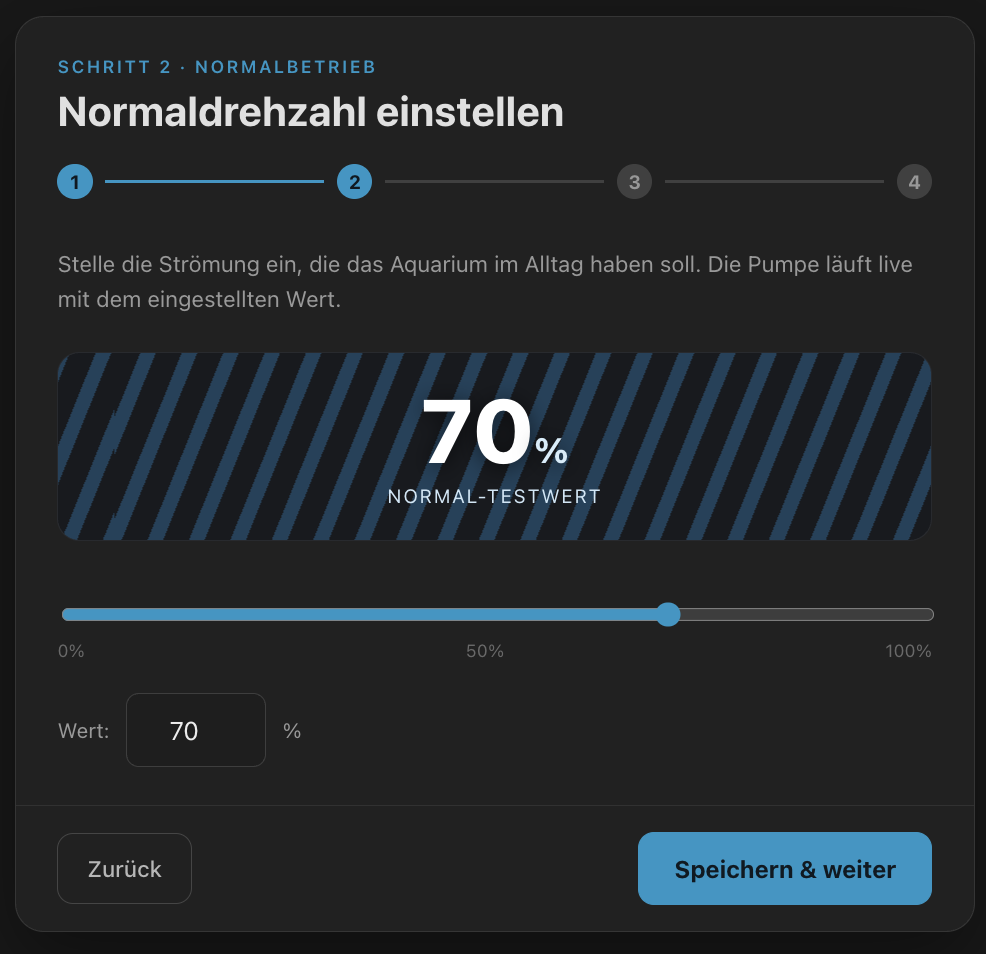
- Speed as an ordinary fan percentage, so it works with everything Home Assistant already offers for that
- Feeding pause as its own controls
- A calibration panel
Explicitly experimental: tested against exactly one MDC-5000 so far. If you have a different model, start carefully.
Infrared and radio
Broadlink Code Manager
v0.2.5Brings order to the infrared and radio commands you have learned through the Broadlink integration. They otherwise sit invisibly in an internal file, and there is no list to pick them from anywhere — so learned commands are easy to lose track of.
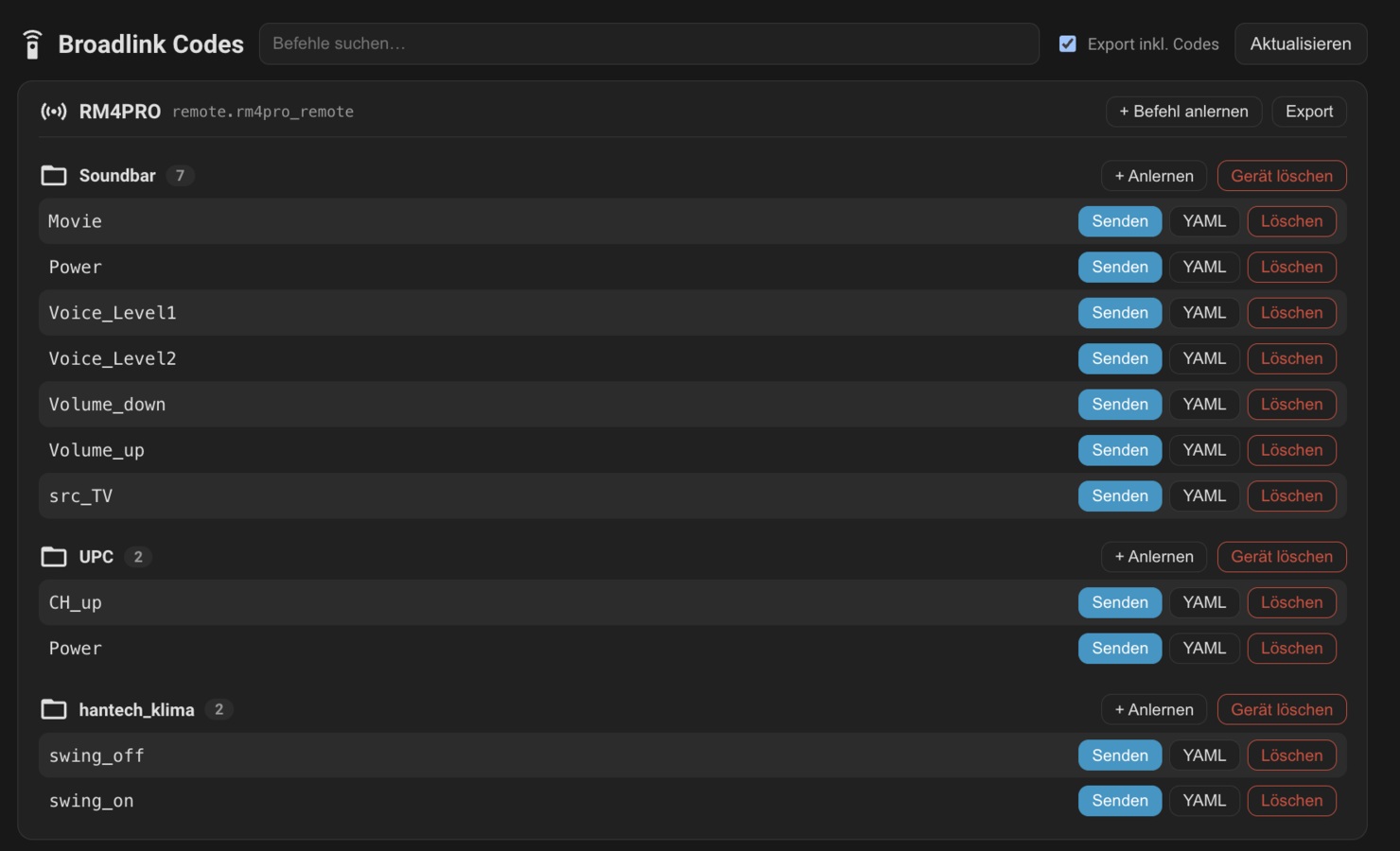
- An inventory grouped by remote, device and command
- Send a command to check it still works
- Learn a new command, with on-screen instructions
- Delete single commands or a whole device
- Copy a ready-made YAML snippet, export a remote as JSON
- Search and filter across every command
It only reads the internal file and never writes to it; every action goes through the Broadlink integration's official services. It does not replace that integration, it complements it. Needs Home Assistant 2024.7 or newer.